Three ways to correct the same mistake
| Method | You say "I have never went there" | What it does |
|---|---|---|
| Explicit correction | "Quick fix: it's 'I have never been there'." | Clear, and it stops the conversation. |
| Recast | "Oh, you've never been there? Why not?" | You hear the right form straight after yours, and the conversation goes on. You might not notice it. |
| Prompt | "Sorry, you have never... what?" | You have to find the fix yourself. It asks more of you and it interrupts more. |
What the research says
- Correction works and lasts. Li (2010) pooled 33 studies and found a medium effect that holds over time. Implicit feedback kept better than explicit.
- Prompts have an edge in classrooms. Lyster and Saito (2010) pooled 15 classroom studies (827 learners) and found prompts beat recasts, most clearly in free responses.
- That isn't settled. Goo and Mackey (2013) argue the case against recasts is weak. Recasts make up 57% of classroom correction in practice for a reason: they are easy to give and keep the talk moving.
- During or after is not settled either. A 2025 review of eight task studies calls the picture equivocal. Immediate feedback was generally better, but the samples are small, most are about grammar, and "delayed" often meant a list of corrections.
- The next day can work. In one small study, 52 learners on video chat were split into four groups. Explicit feedback given 24 hours later, through an edited video of their own conversation, did as well as live feedback. It had about 13 people per group and tested only grammar.
Sounds need more than a recast
Sounds behave a little differently. In a study of 65 Japanese learners, teaching the English r with recasts moved it in controlled and free speech. Teaching alone did not, and neither did nothing. In another study of 49 learners, explaining how the sound is made and starting with an exaggerated model produced larger gains that carried over to unfamiliar words.
So being told how to make the sound matters, and so does hearing it right when it comes up in real talk. This is why Language Boss has both the character's recasts and the side views of the mouth.
What this means for an AI
When ChatGPT is asked to correct you in voice mode, it tends to say something like "tiny tweak" or "might sound more natural" before the fix. George, a linguist on our team, goes through this in OpenAI's own demo. His point is that the second half of what it does is a recast and it is excellent, and the flag in front of it is what takes the learner out of the conversation.
There is a little direct evidence. In a one-hour study of 20 Korean adults, having an AI rephrase a mistake felt more engaging than explicit correction (4.77 against 4.03 for emotional engagement). It measured how it felt, not what they learned.
What Language Boss does
- During the take: the character recasts every mistake in role, at your level, and never announces it. It might say "Oh, so you've never been there before" and carry on.
- Right after: the recap lists what slipped, with pickups to re-say.
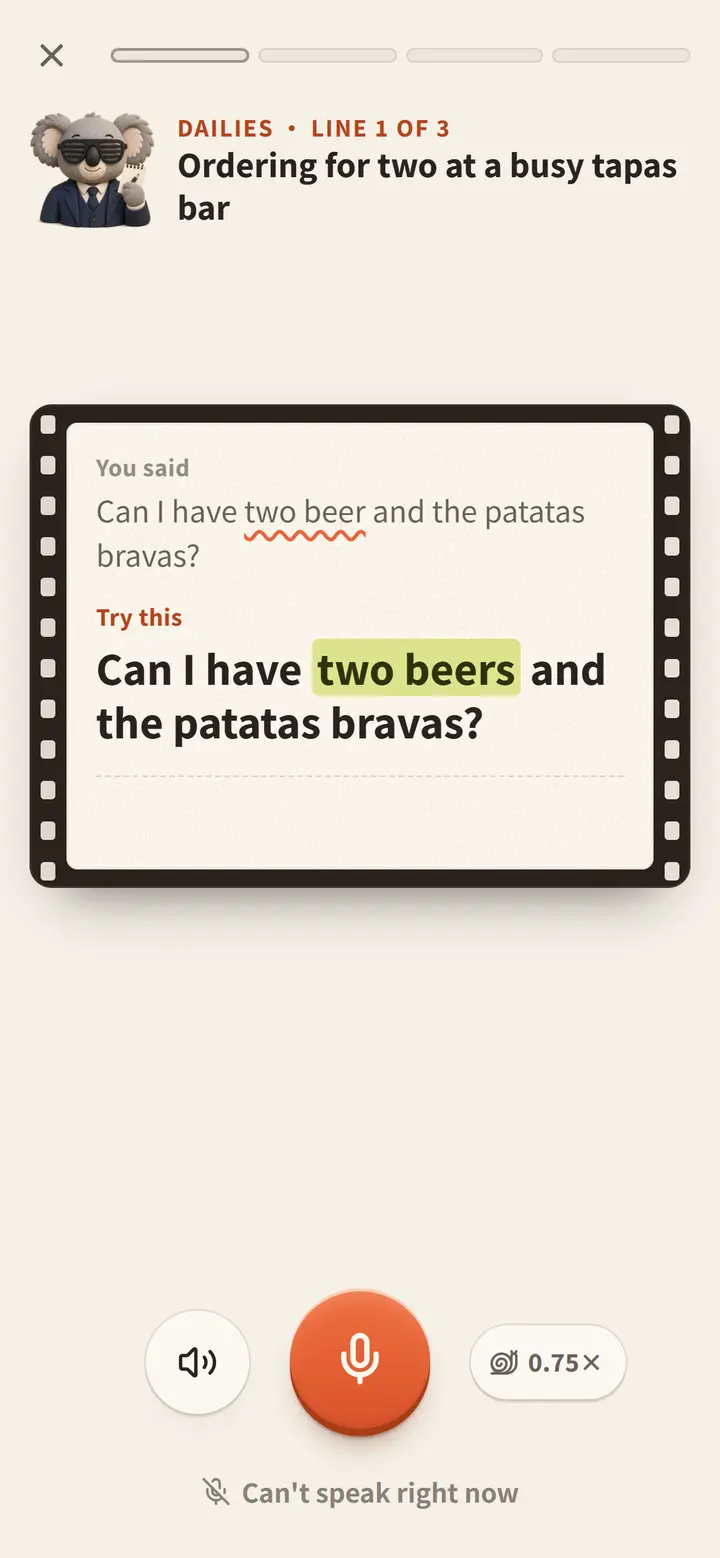
- The next day: dailies bring back your own lines. You see what you said, then the fixed version, and you say it again.
- In later scenes: the next character listens for your top three recurring mistakes, and your corrected lines come back.
- For sounds: every sound is scored after the call rather than during it, so the conversation isn't interrupted, and you're told what it came out as.
If you use ChatGPT, you can get closer to the first half of this by asking for it. Here is a prompt we wrote for that.
Questions
Are recasts better than explicit correction?
They do different jobs. Implicit feedback such as recasts held up better over time in one large review, and it keeps the conversation going. Explicit correction is easier to notice. That is why we use recasts during the call and explicit feedback after it.
Should I ask to be corrected every time?
Learners tend to want more correction than teachers assume, and there is little evidence that it hurts as long as it doesn't stop you. The question is mostly how it is delivered. A recast can fix every mistake without interrupting.
Is it better to be corrected right away?
Probably somewhat, though the evidence is mixed and comes from small studies. A recast is immediate and doesn't interrupt, and going back over your lines later adds the explicit part.
Sources
- Li 2010, Language Learning 60(2)
- Lyster & Saito 2010, Studies in Second Language Acquisition 32(2)
- Goo & Mackey 2013, Studies in Second Language Acquisition
- Li, Ou & Lee 2025/26, Language Teaching 59(1)
- Canals, Granena, Yilmaz & Malicka 2025
- Saito & Lyster 2012, Language Learning
- Saito 2013, Studies in Second Language Acquisition
- Park, Lee, Ma & Yoon 2026, AI Twin
- Lyster, Saito & Sato 2013, Language Teaching
- Brown 2016, Language Teaching Research