Side by side
| What speaking practice needs | ChatGPT voice mode | Language Boss |
|---|---|---|
| What to talk about | You pick the topic and set up any role-play by asking. | Koda writes a scene from your goal. You play a role with missions to complete. |
| Correction while you talk | It does what you ask. Voice mode has no teaching default. In OpenAI's own demo, asked to jump in, it stops the speaker and flags the fix. | The character folds the fix into its reply, in role, at your level. Explanations come after the call. |
| Your sounds | It can say a word and show a phonetic breakdown when you ask. Voice mode doesn't score the sounds you said. | Every sound of every take is scored after the call: "the th in think came out as s", with your word beside the model. |
| Physical feedback | Voice mode has no feedback on your mouth or tongue. | X-ray Mouth draws the tongue and lips over your own cheek. Glass Words cracks the exact letters that slipped. |
| After the call | A transcript, which OpenAI says may differ from what was said. You can ask it for flashcards or a quiz. | A recap with pickups to re-say, dailies with your own lines fixed, and flashcards from what you said. |
| The next session | Memory draws on past chats and picks what seems relevant, and OpenAI says it doesn't keep every detail. It doesn't track your mistakes. | Counts each mistake and sound across all your takes and ranks what to fix first. The next character listens for your top three recurring mistakes, and your corrected lines and weak words come back. |
| Proof you improved | Your own impression. Voice mode doesn't track your progress in a language. | A sound counts as fixed only when it holds in later open speech. Then and Now plays your first slip beside your latest right take. |
| Where it is going | Wherever you steer it. Voice mode has no course or plan for languages. | Your dream becomes objectives and scenes that rehearse them. A screen test on day one and a premiere later compare the same scene. |
A linguist reviews ChatGPT's demo
George, one of our lead engineers, with a background in linguistics, watched OpenAI's language coaching demo from its GPT-Live launch stream. His verdict was "to be honest, it's pretty good", and it uses recasts well. He asks for two changes: stop interrupting with flagged corrections, and stop relying on the learner to invent the topic.

Read the transcript
Hello, I'm George from Language Boss. We've seen that ChatGPT have just come out with a new language learning mode. And since we're also all about using AI to empower language learners, we thought it would be really interesting to take a look at what we have decided to do differently from them. So let's watch this video together, and then I'll come in with my thoughts every now and then.
[The demo: the presenter asks ChatGPT to jump in and correct him, and starts describing a trip to San Francisco.]
Okay. So, from the get-go, he's obviously prepared and planned a lot before this video. So he came here knowing exactly what he wanted to talk about. Now, we've noticed that what's missing from a lot of English learners' curriculum are opportunities to speak English. So we want to give our students as many opportunities to speak English as possible, which means we can't rely on every learner having as much initiative as him to invent their own topics to talk about.
So what we do in our app is we come up with the topics for the learner. We're asking our agents to invent a role-playing situation. They're normally really interesting and really fun. The agent plays one character and the student gets to play another character, and they're told what they should talk about and who they should be playing. This just gives our students more opportunities to speak English without running up against writer's block, and without having to rely on them to come up with the interesting topics.
[The demo: "I have never went to this city before." ChatGPT: "Tiny tweak. I've never been to this city before."]
What ChatGPT just did was almost excellent. So he just used the simple past form of the verb instead of the past participle. And in the second half of what ChatGPT just did, ChatGPT used the correct form of the verb in the sentence: I have never been to this city before. That's called a recast, and we believe this is an excellent form of error correction. But the biggest advantage of recasting is that it doesn't have to interrupt the flow of the conversation. So ChatGPT interrupting him and coming in with a tiny tweak takes him out of the conversation.
We want our learners to develop confidence in speaking English and to become fluent English speakers. So it's really important that they have the opportunity to just string together as many English words as possible in a row, and that the conversation progresses naturally. I'll show you what that looks like in our app at the moment.
[In Language Boss: "I'm planning a trip to San Francisco. I have never went to this city before." The character: "Oh, so you're planning a trip to San Francisco and you've never been there before. That sounds exciting, especially for a first visit. What do you think you'll do there?"]
So, as you can see, the recast was still there. Our agent still corrected my grammar. She's an attentive listener. She listened to everything I said and she repeated it back to me in perfect English. This is called positive evidence. At Language Boss, we really believe in positive evidence. We need to show the learner as many examples of correct grammar, and what is allowed in English, as possible. But for this exercise type, we don't want to interrupt the flow of the conversation and risk making the learner feel uncomfortable or losing a little bit of confidence while speaking English.
[The demo: ChatGPT hesitates, then says the sentence could be polished.]
This kind of stuff, it can be a tiny bit awkward, right? The AI sounds like it's being a little bit awkward on purpose. Don't be afraid to correct the learner. We need to correct the learner. Just do it in the natural flow of the conversation.
[The demo: ChatGPT stops the presenter with "Just a quick fix".]
So that's another example of what I would say is the same kind of shortcoming. I don't think the AI should interrupt him with "just a quick fix". The AI should get straight on to the error correction. We need feedback to be very fast. As a language learner, when we make a mistake, we want the AI to correct us quickly, but it doesn't have to be explicitly marked. It can be implicit error correction, which just means that the learner will absorb it naturally by listening to a lot of correct English.
[In Language Boss: "I am very exciting about this trip." The character: "Oh, you're planning a trip to San Francisco and you're very excited about it."]
So the error correction is still there, but the AI doesn't have to interrupt me or make me feel uncomfortable.
[The demo: the presenter asks why not "exciting", and ChatGPT explains the difference in one line.]
This kind of question that he just asked the AI, and she gave him a summary kind of answer: we're using other exercise types to teach you this kind of grammar. We think that he's probably not going to remember this from that two-second segment.
[The demo: "to take some photos there might sound more natural."]
This would have been a perfect response if ChatGPT didn't add "might sound more natural". Just tell him the correct way to say it: to take some photos there. The learner will definitely notice the correction, especially in this case, and it would be a lot more natural and just build his confidence.
So, to be honest, it's pretty good. Feedback to the learner is one of the most important things to get right. So now, in Language Boss style feedback, I will give their ChatGPT language learning mode some feedback. First, what went well. I think the best thing about this is that it uses a lot of positive evidence and recasting. Positive evidence is just saying what is allowed in English by giving examples, and in this case ChatGPT is giving a lot of examples of the correct grammar, the correct way to say things.
And "even better if": this would be even better, in our opinion, if it didn't interrupt him with explicitly marked corrections. It should just be a flowing, smooth conversation. And a second "even better if" might be: don't rely on the learner to come up with the topic. Give them a really interesting scene or situation to role-play, based on their own interests, so that they will have more opportunities to speak English and build confidence and fluency.
Fixing a mistake without stopping you
Here is the same mistake in both, taken from the review.
OpenAI's demo
- I'm planning a trip to San Francisco. I have never went to this city before.
- Tiny tweak. I've never been to this city before.
Language Boss
- I'm planning a trip to San Francisco. I have never went to this city before.
- Oh, so you're planning a trip to San Francisco and you've never been there before. That sounds exciting, especially for a first visit. What do you think you'll do there?
This is called a recast. It is one half of how we correct. Recasts on their own can be missed, and in classrooms getting learners to fix errors themselves has had an edge, so the other half comes after the call, when your own lines come back fixed and explained. Here is what the research says about correcting spoken English.
You can get closer to this in ChatGPT by asking for it. We wrote a prompt for that, and it's free to copy.
Feedback you can see on your own face
A general-purpose assistant doesn't know what your tongue is doing. To change your accent, you need to change something physical, and it helps to see it. X-ray Mouth tracks your face with the camera, and after you say a phrase it replays your selfie with the tongue drawn over your cheek: red for what it heard, and a green ghost for where it should have gone. No other language app draws it over your own face.
Glass Words is the daily warm-up. A word stands in glass and you say it. If a sound slips, only the letters of that sound crack, so you know which one it was. You can try it on the home page without a mic.
This is how you move your speech towards the way you want to sound, one physical change at a time. Start with the th sound, v and w or ship and sheep.
ChatGPT remembers your life. Koda remembers your English.
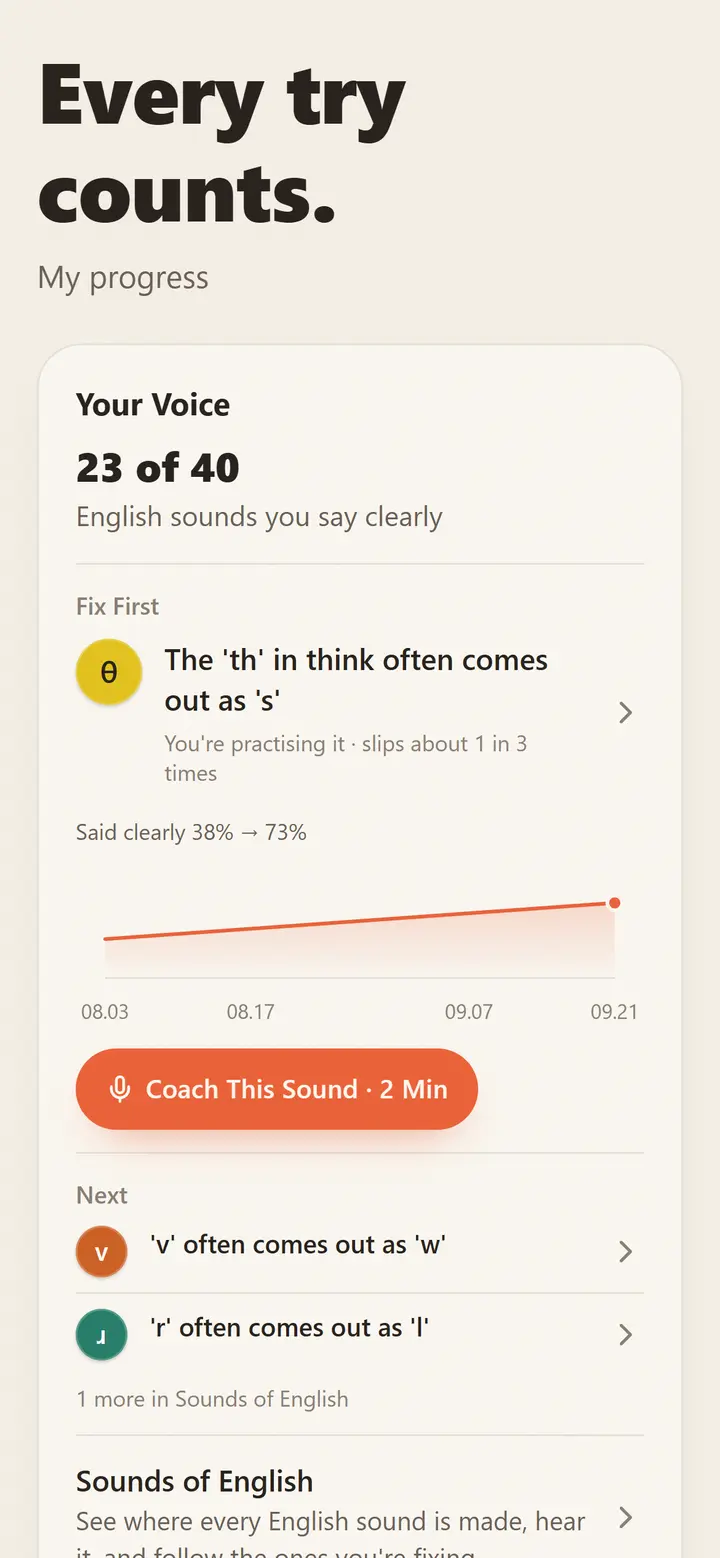
ChatGPT's memory is good at facts about you: your job, your plans, your dog's name. It draws on your past chats and picks what seems relevant, and OpenAI says it doesn't keep every detail. It keeps no record of how you speak. In Language Boss, every sound and every mistake from every conversation is counted, and those counts decide what happens next.
- Voice Coach ranks your sounds by how often they slip, so you always know which one is worth fixing now.
- The next character listens for your top three recurring mistakes.
- Your corrected lines come back in dailies the next day, and your weak words come back in later scenes and in flashcards.
- A sound counts as fixed only when it holds up in later open speech, not when you get it right in a drill.
- Then and Now plays your first slip beside your latest right take, in your own voice.
Playing a role instead of chatting
In a general chat you are yourself, being polite to a machine. In a scene you are someone with something to get done: ordering for two at a busy tapas bar, or booking a table for four at a seafood place in Porto. There is a reason to speak and a reason to keep going, and it is more fun. In a four-month classroom study, teenagers learning English through drama gained fluency that a comparison class did not, and people who enjoy learning a language tend to be more willing to speak it. We go through that research here, including its limits.
It is going somewhere: your dream
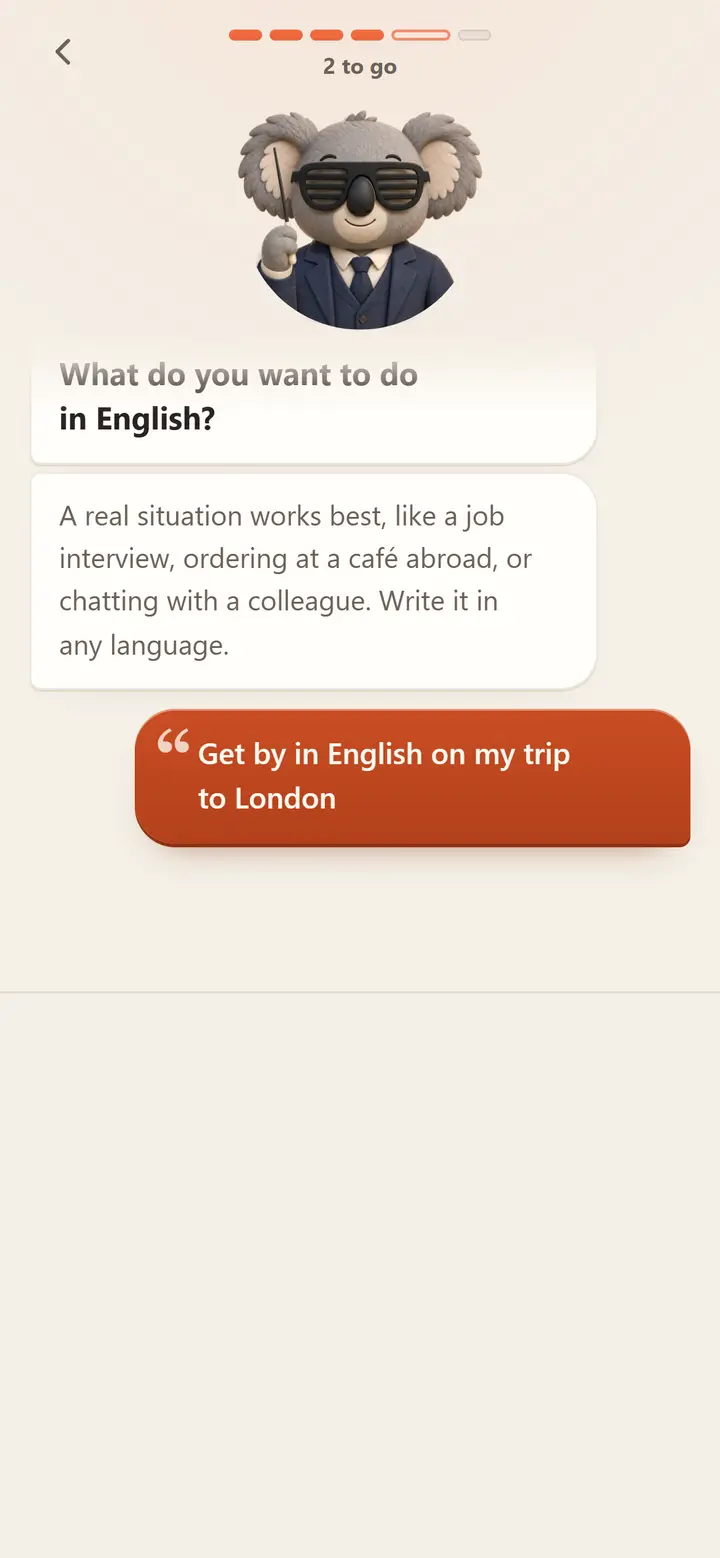
You start by telling Koda what you want English for, in your own words: a real interview next month, a weekend in London, the voice chat you keep muting yourself in. That becomes your objectives, and the scenes rehearse them. On day one you record a screen test. Later, a premiere replays the same scene beside it, so you can hear the distance you have come.
Questions
Is talking to ChatGPT voice mode enough to get good at speaking English?
It gets you talking, which is better than not talking. OpenAI's voice mode doesn't score the sounds you said, track your mistakes over time, show what your mouth is doing or check that a fix held. Those are the parts that change how you speak, and with ChatGPT you would have to do them yourself.
Can ChatGPT correct my pronunciation?
It can say a word, show a phonetic breakdown when you ask and give general tips. OpenAI's voice mode doesn't score each sound you said or show you where your tongue should go. Language Boss scores every sound after the call and tells you what it came out as.
Does ChatGPT remember my mistakes?
Its memory can hold things you tell it, and you could ask it to note a mistake. OpenAI's voice mode doesn't keep a count of your mistakes and sounds across conversations, or use one to plan what you practice. Language Boss does that automatically.
How much does Language Boss cost?
The first scene is free. Table reads, dailies, flashcards, Voice Coach, Sounds of English, the Glass Words warm-up, X-ray Mouth and stickers are always free. Pro covers live calls: scene takes, retakes, chat calls and premieres. There are weekly and annual plans, plus one-off passes that work with Alipay and WeChat Pay.
Who is George?
One of the lead engineers at Language Boss, with a background in linguistics. He works here, so his review is our view, and we say so.